


 The California Chamber of Commerce is part of a renewed push to protect small businesses, nonprofits and public agencies from predatory lawsuits based on an outdated state law.
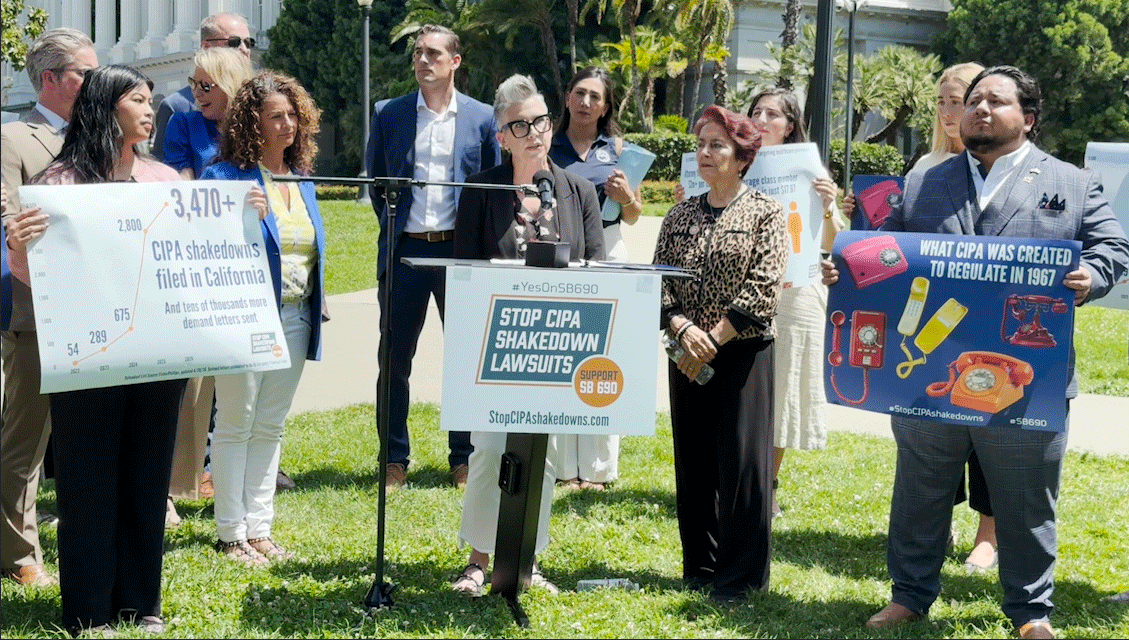
CalChamber joined Sen. Anna Caballero (D-Merced) at a news conference this week to support the senator’s legislation, Senate Bill 690, to stop the abusive lawsuits for typical business activities.
Caballero said at the May 12 news conference that every business with a website in California is vulnerable to litigation and the lawsuits benefit only the trial lawyers who file them.
Trial attorneys are filing the lawsuits using a wiretapping law from 1967, the California Invasion of Privacy Act (CIPA), enacted long before the advent of the internet.
The lawsuits target routine, widely accepted online data practices — such as analytics that help consumers interact with websites — that already are governed by the California Consumer Privacy Act (CCPA), passed in 2018 and amended by voters in 2020.
CalChamber General Counsel Nicole Wasylkiw told news conference attendees that these lawsuits and settlement demands aren’t about consumer protection; they are simply a business model for plaintiffs and their counsel. She went on to state that CalChamber strongly supports SB 690.
Lawsuit Abuse
More than 3,400 California businesses and public agencies have been sued under CIPA in less than two years — over 2,800 of them in 2025 alone.
Just five firms have been responsible for roughly 72% of the litigation; 99% of the so-called shakedown lawsuits are filed against companies such as food banks, community health centers, local museums and small businesses.
These numbers do not include the letters, too numerous to count, offering to settle in the thousands, or the demands for arbitration.
Demand letters allege damages ranging from $20,000 to $5 billion.
SB 690 Protections
SB 690 helps:
- Clarify that activities regulated by the CCPA can’t be the basis for private lawsuits under the CIPA.
- Preserve consumer privacy protections and doesn’t affect criminal cases involving wiretapping, surveillance or recording of communications that are not used for a “commercial business purpose.”
- Reinforce California’s existing privacy enforcement mechanisms.
- Prevent misuse of an outdated law that never was intended to regulate internet activity.
- Protect businesses, nonprofits and community organizations from repeated legal threats.
- Support for SB 690
The coalition supporting SB 690 includes businesses, local chambers of commerce, nonprofits and other statewide organizations from across California.
More information is available at Stop CIPA Shakedown Lawsuits.
SB 690 awaits action by the Assembly Privacy and Consumer Protection Committee.