



The California Chamber of Commerce this week announced the next phases of the “Rate Realities” campaign, calling on lawmakers to get serious about affordability, cut costly mandates, and stop passing legislation that drives up utility infrastructure costs and customer electric bills.
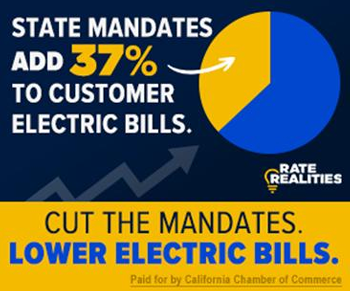
“We agree with the Legislature in its focus on electricity affordability,” said CalChamber President and CEO Jennifer Barrera. “The fastest way to bring down electricity bills is to cut or find alternative funding for costly state mandates that are adding 37% to the average customer’s bill. What’s more, legislators must stop passing misguided and risky proposals that actually increase customer bills.”
CalChamber has launched a statewide digital ad campaign urging lawmakers to cut the mandates and lower electricity bills. The ads can be viewed here.
The Facts
• According to a recent analysis, state laws and mandates add 37% to the average electric bill for customers of investor-owned utilities (IOU), including Southern California Edison, Pacific Gas & Electric and San Diego Gas & Electric, according to a 2025 Blue Sky Consulting Group report. That amounts to more than $820 per year for the average IOU customer.
• A separate analysis from the California Public Advocate’s Office at the California Public Utilities Commission (CPUC) found that customers without rooftop solar are paying more than $8.5 billion every year on their electric bills to subsidize customers with rooftop solar systems. That adds 20% or almost $440 per year to every non-solar customer’s electric bill — primarily hurting low-income families, seniors and renters.
• In addition to the solar cost shift, bill discounts for low-income customers, paying for energy efficiency programs, subsidies to upgrade school air conditioning and plumbing, wildfire prevention efforts, to name a few, all add hundreds to customer electric bills.
• While many of these programs are important, it is unfair to ask electricity customers to subsidize the cost for all, particularly when they are unrelated to the cost of electric or gas service and many of these programs benefit all Californians.
For more information, please visit RateRealities.com.