


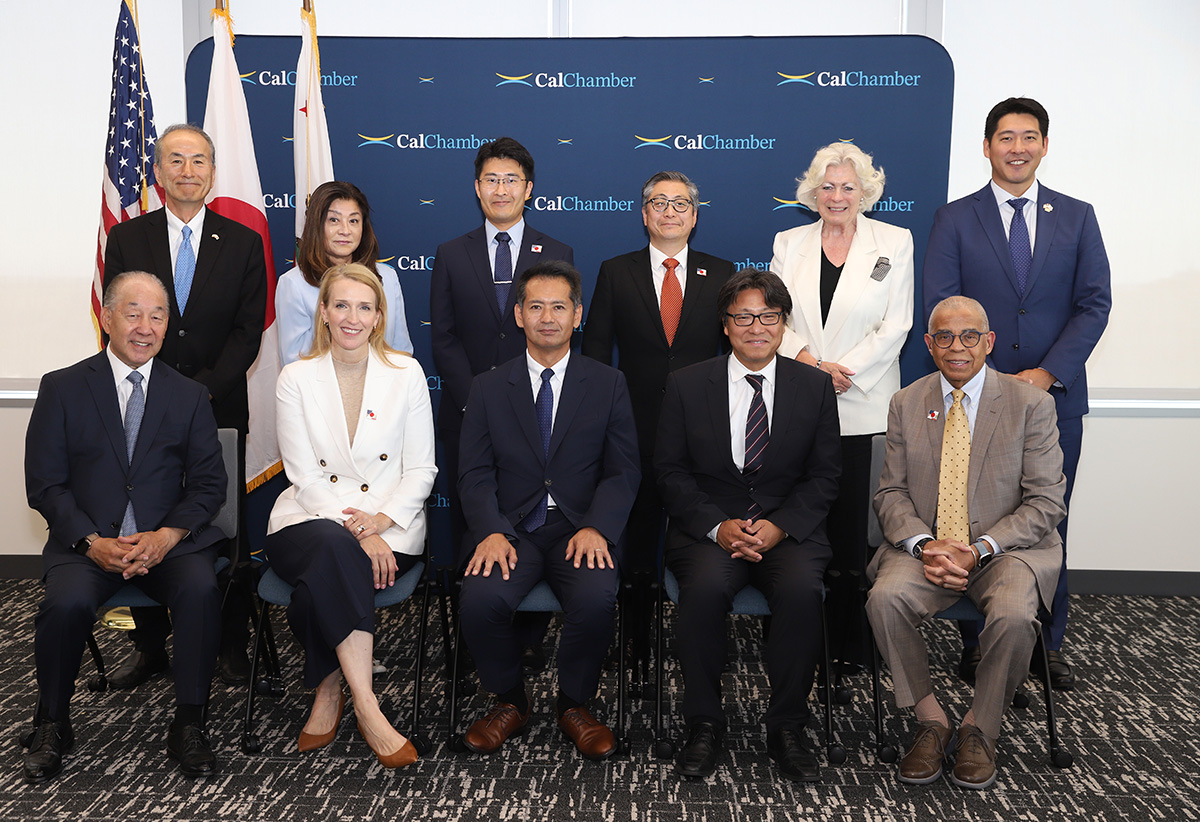
Once again, a working luncheon in Sacramento enabled longtime trade allies from the California Chamber of Commerce and leading associations of Japanese businesses to exchange thoughts on current issues.
The June 24 gathering was the 25th annual visit between representatives from the CalChamber, the Japanese Chamber of Commerce of Northern California (JCCNC) and the Japan Business Association of Southern California (JBA).
Leading the Japanese business delegation were:
• Tetsuya Koide, JCCNC vice president and western states managing officer for Mitsui & Co., Ltd.; and
• Yoshiyuki Hirooka, JBA president and vice president, All Nippon Airways – the Americas.
CalChamber representatives at the luncheon were Jennifer Barrera, president and CEO, and Susanne T. Stirling, senior vice president, international affairs, joined by Frank Washington, first vice chair of the CalChamber Board of Directors and president/CEO of Crossings TV.
Current Topics
Luncheon topics included California’s budget, taxation issues, the overall economy, energy issues, affordability, and incentives for the international community.
Also discussed was CalChamber’s Building an Affordable California Act (Affordable CA), which will appear on the November 2026 statewide ballot as Proposition 45. Passage of the initiative will be a major step toward lowering California’s cost of living by building the essential projects communities need faster and more affordably.
The CalChamber expressed thanks to the Japanese business community for their collaboration in opposing legislation that would have increased taxes for international businesses. Assembly Bill (AB) 1790 by Assemblymember Damon Connolly (D-San Rafael) would have eliminated the water’s edge election — an intentional provision of California’s corporation tax structure — forcing all taxpayers to file on a worldwide combined reporting basis beginning January 1, 2028.
U.S.-Japan Trade
In 2025, two-way goods trade between Japan and the United States was $228.02 billion. Total goods exports were $82.06 billion making Japan the seventh largest U.S goods export market. The top five exports to Japan are chemicals ($14.62 billion), oil and gas ($10.88 billion), transportation equipment ($9.24 billion), computer and electronic products ($8.96 billion), and agricultural products ($6.30 billion).
Imports from Japan to the U.S. totaled $119.51 billion, making Japan the seventh largest import market for the U.S. Top imports from Japan were transportation equipment ($52.67 billion), non-electrical machinery ($25.18 billion), chemicals ($17.12 billion), computer and electronic products ($16.12 billion), and electrical equipment, appliances and components ($10.61 billion).
Services trade between both countries totaled $98.25 billion, with services exports totaling $53.73 billion. Top services exports were other business services, charges for use of intellectual properties, transport services, financial services, and travel.
Services imports from Japan to the U.S. totaled $44.52 billion in 2025. Top imports were transport services, charges for use of intellectual properties, travel, government goods and services, and financial services.
California Trade Facts
In 2025, Japan ranked fourth in California’s export market partners, with exports to Japan totaling $11.01 billion. This is a continuing trend, as Japan has remained fourth in California’s export market since 2010, making it a long-standing trade relationship. The top five exports to Japan last year were transportation equipment ($1.90 billion), computer and electronic products ($1.88 billion), processed foods ($1.36 billion), chemicals ($1.18 billion) and non-electrical machinery ($1.07 billion).
California accounts for roughly 13% of U.S goods exports to Japan. Japan also ranked the sixth largest in California importers, with goods imports totaling $28.92 billion, making California imports 24.19% of total U.S imports from Japan. The top five imports from Japan were transportation equipment ($12.96 billion), computer and electronic products ($3.35 billion), non-electrical machinery ($3.05 billion), chemicals ($3.05 billion), and electrical equipment, appliances and components ($1.34 billion).
Foreign Direct Investment – Japan
Japanese companies are one of the leading sources of foreign direct investment (FDI) in the United States and California. In 2024, Japanese companies invested roughly $819.21 billion in the U.S. They provided up to 968,700 jobs, invested $11.5 billion in innovative research and development, and contributed $82.3 billion to expanding U.S. exports.
Primary industries for Japanese FDI in the U.S. included industrial equipment, auto components, real estate, software and information technology (IT) services, chemicals, and electronic components. U.S. FDI into Japan totaled $57.46 billion in 2024. Select USA
In 2025, Japan was the top investor in California, with Japanese foreign-owned enterprises (FOEs) in California providing 130,008 jobs through 3,501 firms, which led to an estimated $15.6 billion in wages. The top sectors for these jobs are manufacturing, wholesale trade, professional/business services, retail trade, and financial activities (World Trade Center Los Angeles).
Trade Missions
Recent trade missions are another indication of the importance of the ongoing relationship between California and Japan.
Earlier this spring, Assemblymember Jessica Caloza (D-Los Angeles), chair of the Assembly Select Committee on Asia/California Trade and Investment, led a trade mission to Japan, underscoring the state’s continued commitment to strengthening economic, cultural, and business partnerships across the Asia-Pacific region.
The delegation, composed of state legislators, local elected officials, and public and private executives, advanced strategic partnerships across priority sectors: agriculture, health care, infrastructure, technology, and entertainment and lifestyle.
In March 2023, a delegation of California businesses (including the CalChamber) and state agencies led by Lieutenant Governor Eleni Kounalakis and Dee Dee Myers, director of the Governor’s Office of Business and Economic Development, traveled to Tokyo and Osaka for a trade mission to advance business, collaboration and partnership between California and Japan.
Trade Allies
• JCCNC was established in 1951 as a nonprofit corporation to promote business, mutual understanding and goodwill between Japan and the United States. It has been a CalChamber member since 1997.
• JBA, founded in 1961, is a nonprofit organization consisting of nearly 420 Japanese corporations doing business across Southern California. It has been a CalChamber member since 1989.
For more information on California -Japan relations, visit www.calchamber.com/japan.