


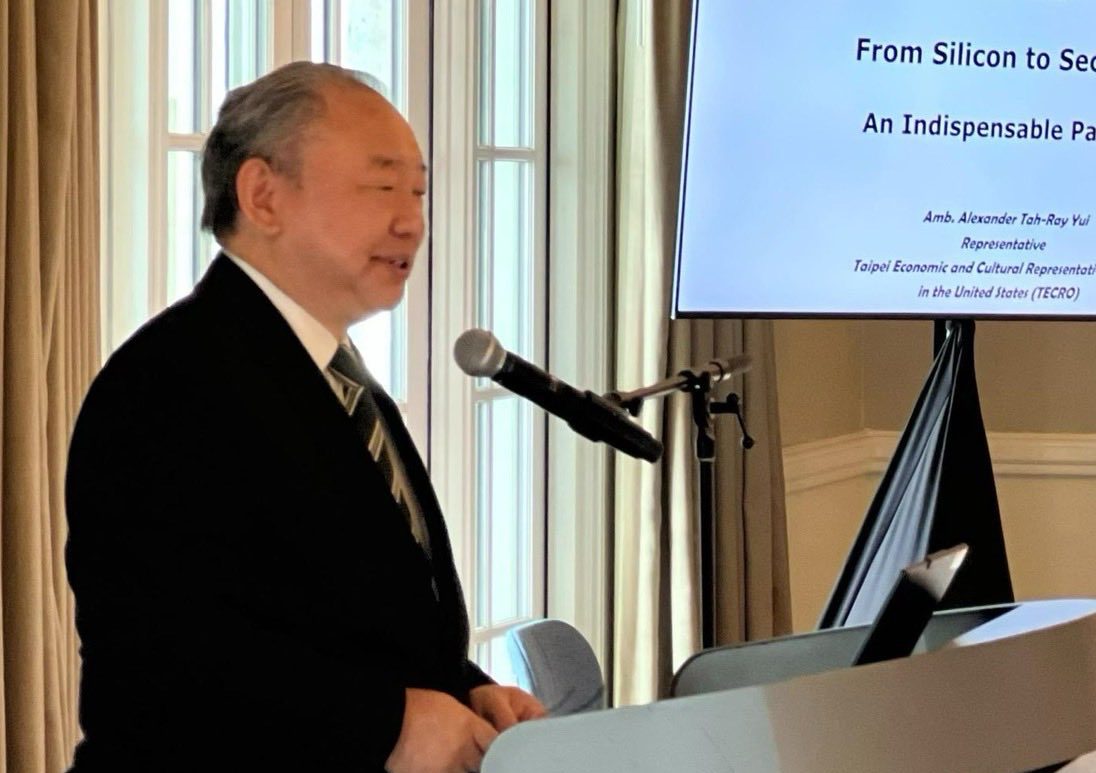
Trade and investment ties between the United States, California and Taiwan remain strong and the economic outlook continues to improve, according to a senior Taiwanese diplomat.
Ambassador Alexander Tah-Ray Yui, Taiwan’s top representative to the United States, gave that assessment at the Sept. 11 breakfast meeting of the CalChamber Council for International Trade (CCIT).
In introducing Yui, CCIT Chair James Low of Rio Tinto Borates noted that California is Taiwan’s second largest source of imports and third largest export market.
As Taiwan’s top U.S. representative since 2023, Yui heads the Taipei Economic and Cultural Representative Office (TECRO) in Washington, D.C. He acts as Taiwan’s de facto ambassador to the United States, leads efforts to strengthen U.S.-Taiwan relations, and oversees 12 TECRO offices throughout the U.S.
Collaboration
Trade, security, science and technology, are key elements of relations between Taiwan and the United States, which signed an Agreement on Reciprocal Trade on Feb. 15, 2026, following 10 months of negotiations.
A top interest for Taiwanese consumers, Yui said, was the removal of quotas and tariffs for U.S.-made cars. In fact, a top Google search topic in Taiwan the day after the agreement was signed, he said, was “US-made Mercedes-Benz SUVs.”
Areas for collaboration include positive uses of artificial intelligence (AI), the supply of rare earth minerals, and — through the U.S.-Taiwan Economic Prosperity Partnership Dialogue — work with NASA and aerospace companies on co-producing and co-developing military equipment.
As part of its strategy of pivoting toward allied democracies, Yui said, Taiwan has been shifting its outbound investment and realigning its trade. Compared to 2010, when 83% of its outbound investment went to China, just 3.75% went to China in 2025 versus 40% to the United States. As of December 2025, U.S. imports from Taiwan surpassed those from China.
Bilateral trade between the United States and Taiwan is growing, Yui said. Taiwan is the fourth largest U.S. trading partner and bilateral trade totaled $256 billion in 2025. Trade is on track to surpass $300 billion this year, he said.
Strengths in Multiple Sectors
Taiwan’s role as a U.S. and California partner in semiconductor and information technology trade gains much attention, but other sectors also are significant. Manufacturers of tools, aerospace essentials, and bicycles have a major presence in Taiwan, Yui said.
And even though Taiwan’s soccer team did not qualify for this year’s World Cup, Taiwan was present at the event in the jerseys worn by nearly every national team that played, he commented. The fabric in the players’ “smart clothing,” known for its capacity to wick away sweat, keep out moisture, and breathe, is made in Taiwan using proprietary intellectual property, he explained.
He remarked that Taiwan once was the No. 1 maker of bridal gowns. Today, it’s the No. 1 maker of the neoprene used in surfer and scuba wetsuits. The change, he said, is a sign of Taiwan’s resilience.

California-Taiwan Trade
Trade between Taiwan and California is flourishing, reaching nearly $78 billion in 2025, Yui reported. Taiwan exports a lot of consumer electronics and semiconductor-related items like AI and data servers, he said, but California also sends a lot of electronics to Taiwan as well.
Taiwan also is the seventh largest buyer of U.S./California agricultural products, including “fabulous wines from Napa,” Yui said. Besides the aforementioned role as the state’s third largest export market and second largest import source, Taiwan also is the 10th largest source of foreign direct investment in California
Information and communications technology remains a strong link between California and Taiwan, he commented. Many Taiwanese engineers worked and trained in Silicon Valley, returned to Taiwan, and now are coming back to the United States to set up factories all over the country, Yui said.